Everything your team will ask.
In one place.
Find the answers relevant to your decision.
Showing all questions.
Using VeroLab
What is Agrivero VeroLab?
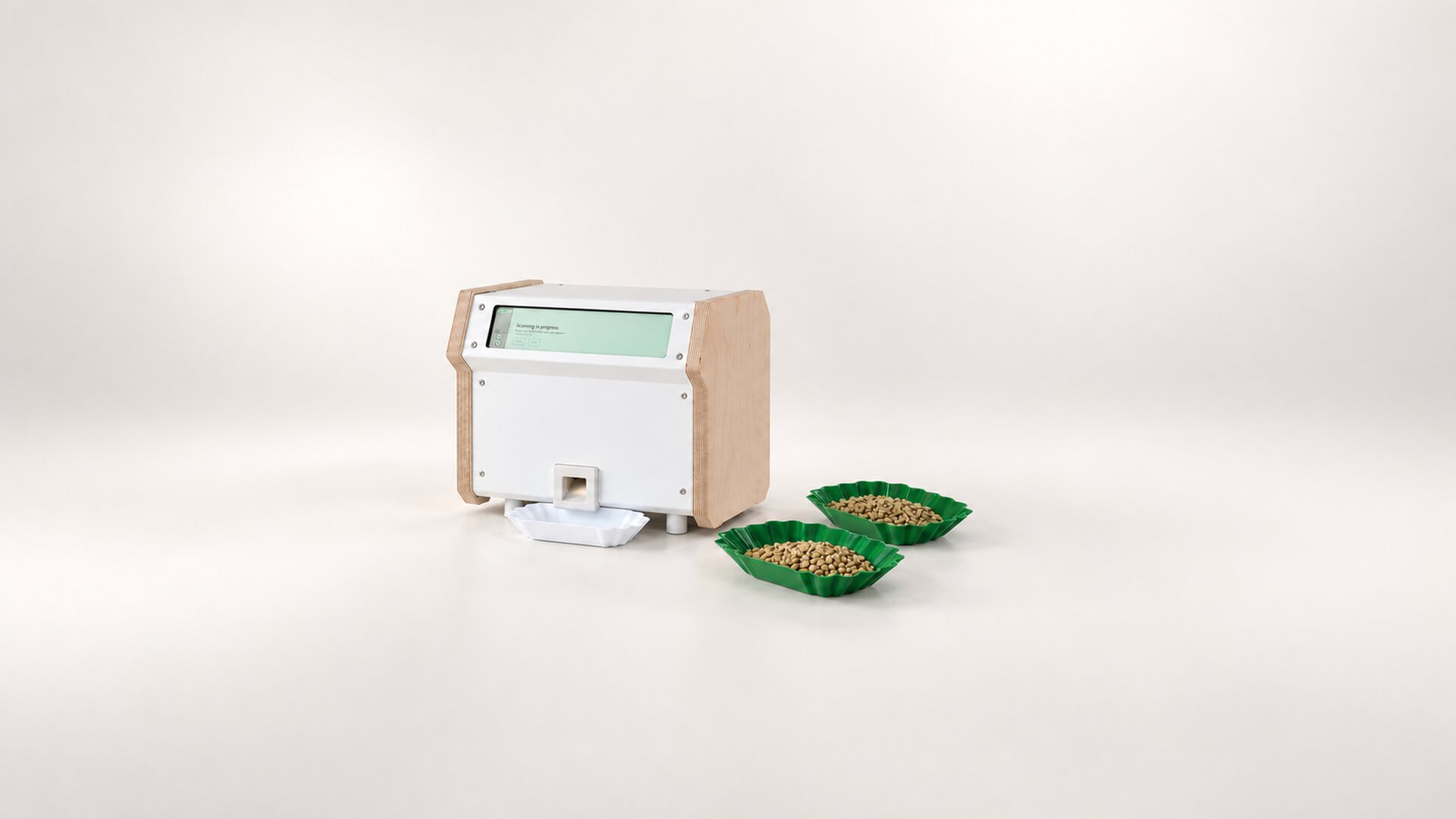
VeroLab is a tabletop device and software platform for analyzing visible physical characteristics of green coffee, including defects, screen-size distribution, and color, and for estimating bean volume and density. Results are presented in a web application, where you can inspect the individual beans behind the analysis.
Link to this answerHow large is the device?
The device measures 38 × 34 × 24 cm, approximately the size of a small printer, and weighs 15 kg.
Link to this answerHow do I register a sample?
You can register a sample on the device touchscreen or through the web application on a computer or mobile phone. Enter the sample ID, origin, processing method, sample weight, and other relevant metadata. With an established API integration, some or all of this information can be retrieved from your ERP system.
Link to this answerDoes VeroLab include a scale and barcode scanner?
Yes. A scale and barcode scanner are included in the standard package.
Link to this answerWhat sample sizes can be analyzed?
VeroLab can analyze samples ranging from a few beans to 500 g. You enter the weight separately for each sample. The recommended sample size is 300–350 g, consistent with most quality standards.
Link to this answerHow long does one analysis take?
A typical 300 g sample takes approximately 4–4.5 minutes. The exact time depends on the number and size of the beans, as well as the amount of small particles and foreign material, because each bean must be separated and captured individually. Low-grade samples with smaller beans and more particles may take 7–8 minutes.
Link to this answerIs there a maximum number of analyses per day or month?
There is no fixed limit on the number of samples that can be analyzed consecutively in one day. Practical throughput depends on the sample size, analysis time, loading and registration time, and your team’s working schedule.
Link to this answerDoes VeroLab physically sort defective beans?
No. VeroLab analyzes and documents the sample, creating a traceable record for each bean. It does not physically sort or separate the beans; they all exit together.
Link to this answerDoes the device clean itself?
After each sample, VeroLab runs an automated cleaning cycle. A vacuum system cleans the imaging area and removes dust and residue. Periodic manual cleaning is still required.
Link to this answerHow often is manual cleaning necessary?
As a general guideline, manual cleaning is required once every two to three months, depending on the volume and dustiness of the samples analyzed. A trained member of your team can perform the cleaning by following Agrivero’s instructions.
Link to this answerResults
What information is included in a sample result?
A VeroLab sample result includes:
- Registered sample information.
- The total number of beans analyzed.
- Screen-size distribution, including bean count, percentage, and estimated weight by screen size.
- Good and defective bean counts and percentages, together with the estimated weight for each defect category.
- Full Bean Equivalent (FBE) calculation and protocol conversion.
- Bean-level images, including three views and confidence scores.
- Sample color information in RGB and CIELAB.
How does VeroLab scan beans?
VeroLab separates the beans from one another and captures three views of each bean, allowing the system to inspect almost the entire visible surface of every bean.
Link to this answerCan I inspect the beans behind the result?
Yes. This is one of VeroLab’s strongest differentiators. You can review any bean, whether classified as good or defective, and see all three views and their associated confidence scores.
Link to this answerWhy are several views of each bean necessary?
Some defects are visible from only one side. The AI model evaluates each view independently, and the predictions are combined to create the final result. This reduces the influence of the bean’s orientation during image capture.
Link to this answerHow are screen sizes calculated?
The software uses all three views to calculate the width and thickness of each bean. It builds a 3D model of each bean in the background. Results include bean counts and estimated weight for each screen-size group.
Link to this answerAre the weight and density of each bean measured?
No. They are estimated rather than measured directly. The estimates use the bean’s calculated volume, shape, classification, the total number of beans analyzed, and the known total sample weight.
Link to this answerDoes the system provide color analysis?
Yes. RGB and CIELAB color information is available as an average for the entire sample and for each defect category. These values can help inform color-sorter settings.
Link to this answerDoes VeroLab measure moisture or water activity?
No. The current visible-light product does not directly measure moisture or water activity.
Link to this answerCan two samples be compared?
Yes. VeroLab provides a workflow for comparing pre-shipment and arrival samples linked by sample ID. The comparison quantifies differences in screen sizes, defect categories, and color.
The comparison does not claim to prove that two samples are identical or that fraud has occurred.
Link to this answerCan results be exported?
You can export an individual sample as a PDF in two formats:
- A summary report without bean-level images.
- An extended report with bean-level images.
You can export multiple samples as a CSV file, with each sample represented by one row.
Link to this answerCan the grading protocol be changed after analysis?
Yes. The AI model recognizes supported defects independently of the protocol used to display the results. This allows the result to be recalculated and displayed under another supported grading protocol.
Link to this answerAI and confidence
How does the AI make a decision?
The AI model evaluates the available views of each bean separately and generates confidence scores for possible defect categories. The aggregation layer then combines the view-level predictions and applies defined rules to produce the final bean-level defect label.
Link to this answerWhat is a confidence score?
A confidence score indicates how strongly a view resembles a particular defect category based on examples in the training data. It does not indicate that the complete sample is “X% accurate.”
Link to this answerWhat happens when a bean may have two defects?
The AI model can identify several candidate labels for a single bean. The applicable aggregation and grading-profile rules determine the final label.
For example, a bean may resemble both a broken bean and a part-black bean. The relevant precedence or severity rules determine which defect label is ultimately applied.
Link to this answerWhat is the difference between the AI model, grading protocol, and grading profile?
- AI model: Identifies visible characteristics and possible defect classes independently of the selected grading protocol.
- Grading protocol: Determines how recognized defects are named, counted, and converted into Full Bean Equivalent.
- Grading profile: Applies agreed thresholds, precedence or severity rules, and internal specifications for a particular origin, processing method, product, or grading methodology.
How is the AI model trained?
Agrivero’s AI model is trained on beans from multiple origins, processing methods, and harvests. It is not limited to a single region or grading profile. Over several years, we have worked with qualified graders to annotate images and expand the training data.
Link to this answerHow can I provide feedback on an AI classification?
You can use the feedback function available for each bean and select a more appropriate defect category.
Link to this answerDoes the AI model learn immediately when I correct one bean?
No. Feedback is reviewed and incorporated into a later AI model update or grading-profile adjustment. Correcting a single bean does not instantly retrain the current model.
Link to this answerCan grading strictness be adjusted?
Yes. During onboarding, we can align thresholds and aggregation rules with your grading methodology. A self-service grading-profile editor is planned for a future release.
Link to this answerWhat does “calibration” mean?
We distinguish between two different processes:
- Device calibration: Technical calibration of the physical device or camera system. We can manage this remotely.
- Grading alignment: Ensuring that VeroLab’s output matches your grading protocol, terminology, and internal methodology. This forms part of the onboarding workshop and the alignment process between your quality team and ours.
How is the product verified?
We verify VeroLab results by comparing them with manual grading across a wide range of samples using supported protocols, including SCA, New York, and COB.
Link to this answerCan Agrivero provide an accuracy guarantee?
We provide a defined validation and grading-alignment report using representative samples. A general guarantee that every result will match every human grader is not realistic because graders, terminology, and protocols may differ.
Link to this answerDoes VeroLab replace a Q Grader?
No. VeroLab can reduce repetitive physical grading work, but it does not replace cupping, professional judgment, or final commercial responsibility.
Link to this answerCoffees and protocols
Does VeroLab work with Arabica and Robusta?
Yes. VeroLab supports both Arabica and Robusta green coffee. The protocol used to count and convert defects may differ.
Link to this answerDoes it work with specialty and commercial grades?
Yes. VeroLab is suitable for both clean specialty samples and lower commercial grades. Lower grades may require more processing time because they often contain more beans, fragments, and foreign material.
Link to this answerDoes it work with washed and natural coffee?
Yes. However, natural coffees have greater color variability. Grading profiles and thresholds may need to be adjusted to distinguish acceptable process-related color from visible defects.
Link to this answerWhat about honey, anaerobic, or strongly fermented coffee?
These coffees may require additional grading alignment and sample review, depending on the exact appearance of the beans.
Link to this answerWhich grading protocols are supported?
VeroLab currently supports SCA, COB (Brazil), and New York grading protocols. See the protocol-coverage matrix for the current status of origin-specific protocols.
Link to this answerCan Agrivero support our internal grading standard?
Potentially. We can support internal standards through protocol mapping, grading profiles, thresholds, and precedence rules. We first review your standard and representative samples to determine whether the work is standard configuration or custom development.
Link to this answerWhat happens when our protocol contains a defect class that the AI model does not yet recognize?
This requires custom development. The defect category must first be mapped, representative examples must be collected and labeled, and the AI model or protocol layer must then be updated. We scope this work separately rather than treating it as instant configuration.
Link to this answerSoftware and modules
What is included in the core product?
The core product includes:
- The VeroLab device.
- The AI Grading License, including: sample registration, standard sample results, bean-level review, supported reports and exports, and standard software and AI model updates.
What are the additional software modules, and are they necessary?
We are developing optional software modules that use green coffee grading data in other areas of coffee operations:
- Cupping.
- Blending.
- Trading.
- Roasting.
These modules are not required to use VeroLab’s core AI grading functionality.
Link to this answerDoes the Cupping Module perform the cupping?
No. The Cupping Module provides a place for your quality team to record sensory results within the same sample record used for green coffee grading. Human cupping remains necessary.
Link to this answerWhy combine green grading and cupping data?
Combining the data creates a single sample history and may help your quality team identify relationships or irregularities between physical and sensory results, supplier changes, and crop-to-crop variation.
Link to this answerCan we use our own cupping form?
Agrivero currently supports CQI- and CVA-style forms. Multi-user and custom-form functionality is still in development.
Link to this answerWhat is the Blending Module?
The Blending Module uses available lot data to visualize how different coffees could be combined to meet targets for screen sizes, defects, sensory profile, and financial outcome.
Link to this answerDoes the system automatically decide which lots to blend?
No. Your team remains in control. The software may provide visualizations or suggestions, but it does not make autonomous commercial decisions.
Link to this answerWhat are the Roasting and Trading Modules?
These are early-stage or roadmap modules that would use green coffee grading data for roasting integration and quality-to-price benchmarking. They are not part of the current core product.
Link to this answerData and API
Where does the analysis happen?
Image processing and AI analysis take place locally on the device. Results are then synchronized with the cloud for remote access through the web application.
Link to this answerIs an internet connection required at all times?
No. VeroLab can continue analyzing samples and displaying results on the local network during an internet interruption. Remote access through the web application and cloud synchronization require an internet connection.
Link to this answerWho owns the data?
Your company owns the sample metadata and sample results. The applicable contract grants Agrivero the right to process the data and use anonymized or otherwise protected data to provide and improve the service.
Link to this answerHow long are images stored?
Processed bean images and sample results are synchronized with the cloud and stored for one year. Longer retention can be configured separately.
Link to this answerIs an API available?
Yes. A standard API is available, allowing you to retrieve VeroLab results into another system.
Link to this answerCan VeroLab operate without an API?
Yes. You can use the web application as a standalone system to register samples and review results. An API integration primarily reduces duplicate data entry and enables more advanced analysis across systems.
Link to this answerDoes Agrivero use customer images to improve the AI model?
Under the license agreement, your company grants Agrivero the right to use anonymized bean images to improve the AI model.
Link to this answerWhere is cloud data stored?
The data is stored on Agrivero-managed server infrastructure in Berlin and with Hetzner, a German cloud provider.
Link to this answerIs the API one-way or two-way?
The standard API is currently one-way, allowing your system to retrieve VeroLab results.
A two-way integration that also retrieves sample metadata from your system requires separate technical definition and scoping.
Link to this answerInstallation and support
How is the device shipped and installed?
VeroLab is shipped in a protective case. To install it, place it on a suitable workspace, connect it to power, and connect it to a stable Wi-Fi network.
We provide remote support for setup. On-site installation or training is optional but recommended.
Link to this answerWill the device operate at 110 V and 220 V?
Yes. We provide a power cable appropriate for the installation location.
Link to this answerWhat happens during the Customer Success and Onboarding Workshop?
We offer a modular two-day workshop covering:
- Review of your use cases for VeroLab.
- Introduction to AI technology and the VeroLab product.
- Portfolio sample testing and initial grading alignment.
- User training and workflow integration with the quality team.
- Requirements review and planning for future adjustments.
- Definition of customer-success metrics and KPIs.
Because the workshop is modular, different team members can join the sessions most relevant to their roles. We recommend participation from:
- The Head of Quality and members of the quality team.
- Buyers and traders.
- IT representatives.
- The Head of Sustainability, where applicable.
What happens if the device has a problem?
We first provide remote support and guide your team through troubleshooting. If the issue cannot be resolved remotely, our team will service the device in Berlin.
Link to this answerWill the hardware need to be replaced when the software improves?
No. VeroLab is designed to support long-term software and AI model updates on the existing hardware.
Link to this answerOffer and procurement
How can I receive an offer?
You can configure your selected devices, modules, and services through the offer configurator. Once you submit the configuration, we review it and send a formal offer to your email address. Please allow up to 24 hours to receive the offer.
Link to this answerWhich modules and services are mandatory, and which are optional?
The core VeroLab solution requires two components:
- The physical device.
- An active AI Grading License.
All other modules and services are optional and can be added separately.
Link to this answerWhat is the AI Grading License?
The AI Grading License is the software license required to use AI grading on one VeroLab device. It provides access to sample registration, AI analysis, sample results, bean-level review, the web application, supported reports and exports, and standard software and AI model updates.
Link to this answerWhy is the AI Grading License a recurring fee?
The recurring fee supports continued access to the software service, AI model improvements, grading-protocol updates, software updates, data services, and the web application.
Link to this answerIs the AI Grading License per company, user, or device?
The license is per device. There is no separate fee for individual user seats.
Link to this answerHow long is the initial contract?
The initial license term is two years and renews automatically.
Link to this answerCan I rent or pilot the device?
We do not currently offer rentals because of limited device inventory. Instead, we recommend the following validation process:
- Send up to five representative samples.
- Review the results with our team.
- Visit Agrivero for an on-site test where practical.
- Use a defined acceptance process after delivery.
How many samples can be sent free of charge?
The standard validation process includes analysis of up to five representative samples at no charge.
Link to this answerWhat is the delivery time?
The production lead time is approximately four months and depends on our production schedule. We currently run two production cycles per year, in spring and autumn.
Link to this answerWhat can Agrivero provide for procurement approval?
We provide a downloadable procurement package together with the offer. It includes:
- An official quotation.
- Technical specifications.
- Product and company information.
- Compliance documentation.
- A warranty and maintenance overview.
- An IT and security information sheet.
- An implementation timeline.
Have enough answers to take the next step?
Tell us how VeroLab would be used in your organization, and we will prepare a formal offer.